A church tower is easy to see. The history behind it is harder to see.
The churches in Banff and Canmore introduce a wider story: travelling missionaries and the Indigenous guides who travelled with them, railway towns, nursing sisters and family life. That story also includes the harm done through church-run residential schools, and a responsibility to remember it honestly.
This is the last part of FaithFinder’s Faith in the Mountains series. Part 1 explores the historic churches in Banff and Part 2 follows the churches in Canmore. Here we step back to look at the valley as a whole, from Morley to Banff.
A landscape already rich in meaning
Long before any church was built, these mountains were known, named and prayed in. The Canmore Museum notes Indigenous connections to the Bow Valley reaching back more than 10,000 years. It names the Stoney Nakoda, Blackfoot, Tsuut’ina, Ktunaxa, Secwépemc, Dene, Mountain Cree and Métis among the peoples for whom the area holds longstanding significance (Canmore Museum).
The Stoney Nakoda Nations describe themselves as the original peoples of the mountains, the Iyarhe Nakoda. Their territory ran from the plains to the foothills and over mountain passes into the British Columbia interior. The Bearspaw, Chiniki and Goodstoney First Nations signed Treaty 7 at Blackfoot Crossing on September 22, 1877. Their language is still spoken in council, at community events and in ceremony.
Many familiar places carry Nakoda names. Minnewanka means “sacred waters.” Morley is Mini Thni. Today the three Nations sit with other First Nations and Métis representatives on Banff National Park’s Indigenous Advisory Circle.
This is where the story of Christianity in the Bow Valley has to begin. Missionaries arrived in a landscape already full of knowledge, relationships and faith.
Travelling ministries came first
Robert Rundle reached Fort Edmonton on October 18, 1840, as a Wesleyan Methodist missionary and Hudson’s Bay Company chaplain. He went into the Rocky Mountains only twice, according to the Dictionary of Canadian Biography: in 1844, to the area near the mountain that now bears his name, and in 1847, to Lake Minnewanka.
He did not travel alone. From late 1841, his interpreter William Rowland made his work possible. From 1844 he was joined by Benjamin, son of the Cree leader Maskepetoon. Rundle preferred large camp meetings to building mission stations. A riding accident in 1847 left him with an arm that would not heal, and he left for England in 1848 and never returned.
Catholic missionaries travelled these mountains too. In 1845, the Jesuit Pierre-Jean De Smet crossed into the Spray Lakes valley. There he baptized six children and an elderly man, the first Catholic baptisms in what is now the Diocese of Calgary (Canmore Museum, parish-submitted history).
Faith also took root on Indigenous terms. In 1858, the Palliser Expedition camped beside Stoney families on the Bow. As the McDougall Stoney Mission Society recounts from Dr. James Hector’s journal, the expedition woke to the sound of Stoney hymns, and no one went hunting because it was Sunday (McDougall Stoney Mission Society). That was fifteen years before a mission was established nearby.
In 1873, Methodist missionaries George and John McDougall arrived with their families. Two years later they moved to a natural ford on the Bow River, a traditional Stoney camping place where many trails met. The church at Morleyville was built in 1874 and 1875 and became the heart of a settlement of more than 200 people.
In 1979, the church was designated a historic site by both the United Church of Canada and the Government of Alberta. In the early hours of May 22, 2017, it burned. About 80 per cent of the original logs were salvaged, and specialists restored the church in 2020 and 2021. It stands today on Highway 1A between Cochrane and Banff, restored rather than untouched.
Railway towns built places to gather
The railway changed everything. The first Mass in the Banff area was celebrated in 1883 at CPR Siding 29, near Cascade Mountain (St. Mary’s Parish). Early Presbyterian services in Banff met in a railway section house. Catholic priests who followed the line to serve labourers and miners came to be called “Chaplains of the Line.”
In Canmore, church halls hosted the literary society, the Ladies Aid, choirs and the Young People’s Society, bringing miners, railway workers and townsfolk together. Ministers spent summers in Banff serving tourists and travelled the year round to other mining and railway camps (Canmore Museum).
Some of those camps are gone. Bankhead, a coal town on the road to Lake Minnewanka, had its own Catholic church, Most Holy Trinity, finished in 1908. The mine closed in 1922 and the town was abandoned. Its altar stone now rests in St. Mary’s in Banff.
Seen this way, a small church building carried a great deal. Worship shared space with music, conversation and the practical work of helping neighbours know one another.
The sisters who built the valley’s care
The history of Christianity in these mountains is also a history of nursing. In 1930, the Sisters of St. Martha of Antigonish, Nova Scotia, came to Banff at the invitation of the Bishop of Calgary. They bought the Brett Sanatorium, which had stood empty for four years, for $58,000 (St. Mary’s Parish).
They found pack rats in the mattresses and bats in the attic. Mineral scale had built up so thickly in the pipes that it had to be chipped out with hammers and chisels. On July 14, 1930, the renovated building opened as Mineral Springs Hospital.
In 1934 the Sisters opened a social service centre and kindergarten in Canmore (1960 hospital anniversary booklet). They opened a new hospital in Banff in 1958 and a third in 1987, then handed governance to a Catholic health organization now called Covenant Health. The last sisters left in 1988. The hospital’s continuing care unit was named St. Martha Place in their honour.
Their story is a reminder that a faith community’s legacy is not only in its buildings. It is also in the clinics, classrooms and kitchens it helped start.
Remembering the residential school history
An honest history of Christianity in the Bow Valley must include church-run residential schooling.
The United Church of Canada’s archives record that the Methodist Missionary Society ran the McDougall Orphanage and Training School near Morleyville from 1883 to 1908. A temporary semi-boarding school followed from 1922 to 1926. Morley Residential School then operated on the Stoney reserve from 1926 to 1969, managed by the United Church (The Children Remembered; National Centre for Truth and Reconciliation).
The same archives show that church officials sought to separate children from their families and culture. Stoney parents petitioned again and again for day schools in their own communities, citing their treaty rights. The record also includes allegations of severe corporal punishment and physical abuse, and one conviction for sexual abuse. The NCTR’s record for the school remembers, by name, children who died.
The United Church of Canada has apologized for its role in residential schools. For Christian readers, learning this history is part of approaching the region’s heritage with truthfulness and humility, and listening first to Survivors and to Stoney Nakoda voices. The McDougall Stoney Mission Society shares Îyârhe Stoney Stories, told by community members.
If this history affects you or someone you know, the National Indian Residential Schools Crisis Line is available at 1-866-925-4419.
Continuing the story today
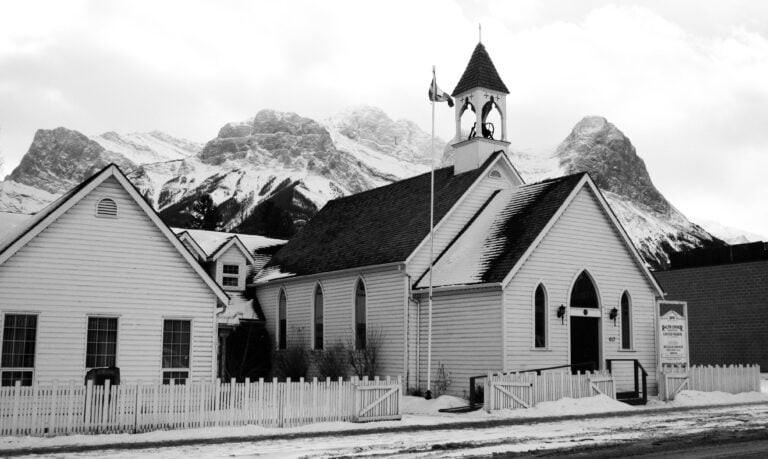
The churches of the Bow Valley keep adapting to the people around them. Ralph Connor Memorial added a Wednesday evening service for service workers whose weekends fall midweek. Canmore’s Catholic parish dedicated a new shrine in 2020. Rundle Memorial and Ralph Connor joined as one congregation in 2023. St. George-in-the-Pines serves free meals every Monday.
When you visit, look at the building, then ask about the community around it. How did it begin? Who kept it going? How does it serve its neighbours now? Those questions open a deeper understanding of faith in the mountains, and of the people who have called them sacred for far longer.
Want to connect this history with a visit? Explore FaithFinder’s directory of churches in Alberta and search Banff or Canmore.
Read the series: Faith in the Mountains
- Historic churches in Banff
- Churches in Canmore and their history
- Christianity in the Bow Valley (you are here)