Churches in Banff and the Stories Worth Stopping For
Faith in the Mountains · Part 1 of 3
In the winter of 1930, a church in Banff went for a ride.
The original St. Paul’s Presbyterian Church was put on a sled and moved from near the Bow River to its present site on Banff Avenue. A new sanctuary was added, and the little building became the church hall. Almost a century later, it is still part of the church.
It is a good story to take with you on a walk through town. Among the historic churches in Banff are buildings that people saved, enlarged and worked for over generations. Once you know something about those people, a church you might have passed on the way to lunch becomes a reason to stop.
St. Paul’s began in 1887 with Scottish railway workers looking for a Presbyterian congregation during the summer. The parish’s account of its beginnings is brief, but that journey on a sled leaves a lasting image: an old place of worship finding room in a new one.
Building St. George in the Pines
Elsewhere in town, another congregation was learning how long a church could take to build.
Anglicans had first gathered in a log cabin on Bear Street. They laid the cornerstone for St. George-in-the-Pines in 1889, but money came slowly. The building grew a section at a time, as the congregation could afford it.
That makes the stone church look a little different. Its finished walls can seem inevitable from the pavement. The people who started it had to live with an unfinished building and keep finding ways to carry on.
Then came the bells. Cast in England, the eleven bells travelled to Banff through the Panama Canal and were installed in 1927. Inside the tower, a player operates their clappers from a keyboard-like instrument called a clavier. The bells themselves stay still. Alberta’s heritage record preserves both their journey and the congregation’s patient building work.
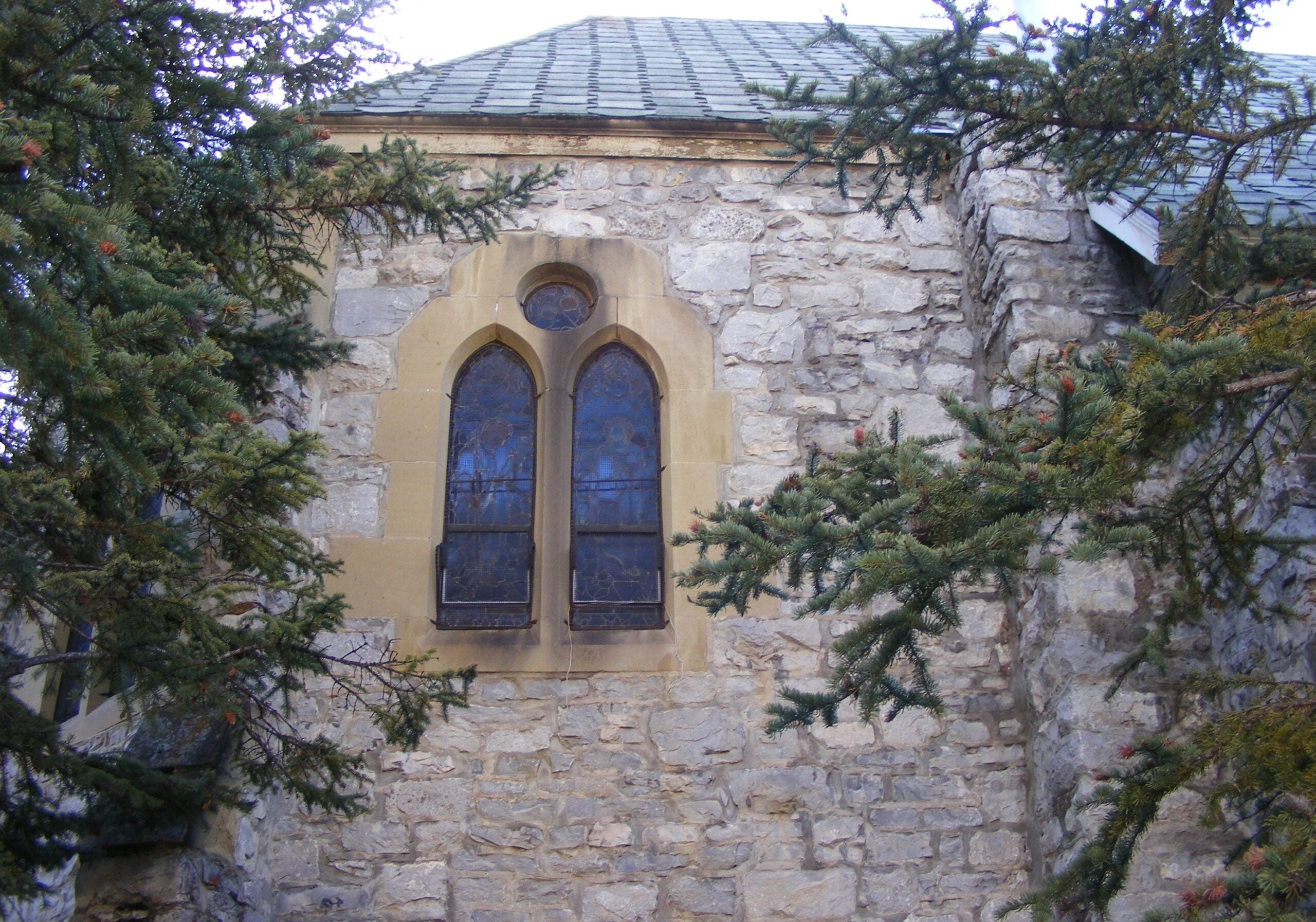
The parish remembers its long-serving rector, Canon Tully Montgomery, playing the bells on summer evenings. Inside, a window commemorates mountain guide Sid Unwin, who was killed in the First World War. Another brings Lake Louise and Mount Victoria into the church in coloured glass. These details introduce the people and places the congregation wanted to remember. St. George’s history tells their stories.
A mountain landscape inside St. Mary’s
At St. Mary’s, look closely at the Nativity window.
Moose and deer gather around the infant Jesus. He rests on Alberta wheat, with the Bow River in the scene. The landscape is recognizably close to home.
The windows were designed by Father Robert McGuinness, an engineer before he became a priest. His parish remembers a Jewish friend who prayed in the old church when Banff had no synagogue. That friend, the parish says, donated the Nativity window in memory of relatives killed in the Holocaust. A Star of David appears above the scene. St. Mary’s preserves the account in its parish history.
Knowing that story changes what you notice. A familiar Christmas image also holds the memory of a friendship and a family’s loss. It deserves a little time.
Rundle Memorial and a place to belong
The stories continue into living memory.
When Marlo Reid-Gibson moved to Banff from Manitoba, she missed having her extended family nearby. Her grandfather suggested going to church. Recalling her welcome at Rundle Memorial in a 2022 United Church article, she described finding “a little bit of home.”
By then, the congregation faced a familiar question for a small church: where should its limited energy go? Its thrift shop, play school and support for a refugee family mattered deeply to its members. Joining with Ralph Connor Memorial in Canmore offered a way to share the work. Today, the Ralph Connor community serves both towns.
That brings the walk back to St. Paul’s and its remarkable move. Across these churches, people have kept finding ways to carry something precious forward. Sometimes that has meant another section of wall, a memorial window or a partnership with neighbours. Once, it meant a sled.
Visiting churches in Banff
These churches belong to a much longer spiritual landscape. The Stoney Nakoda Nations describe their continuing relationships with these mountains, extending far beyond the history of the town’s congregations.
If you plan to visit, check opening arrangements and worship times directly with each church. For Rundle Memorial, confirm the worship location through Ralph Connor’s website, which covers both Banff and Canmore.
Leave yourself time to look at one window properly or ask about something that catches your attention. A short visit can become a much more memorable part of your day.
Explore FaithFinder’s church directory to look for churches in Banff and elsewhere in Alberta.
Next in the series: Churches in Canmore and the People Who Built Them.