Churches in Canmore and the People Who Built Them
Faith in the Mountains · Part 2 of 3
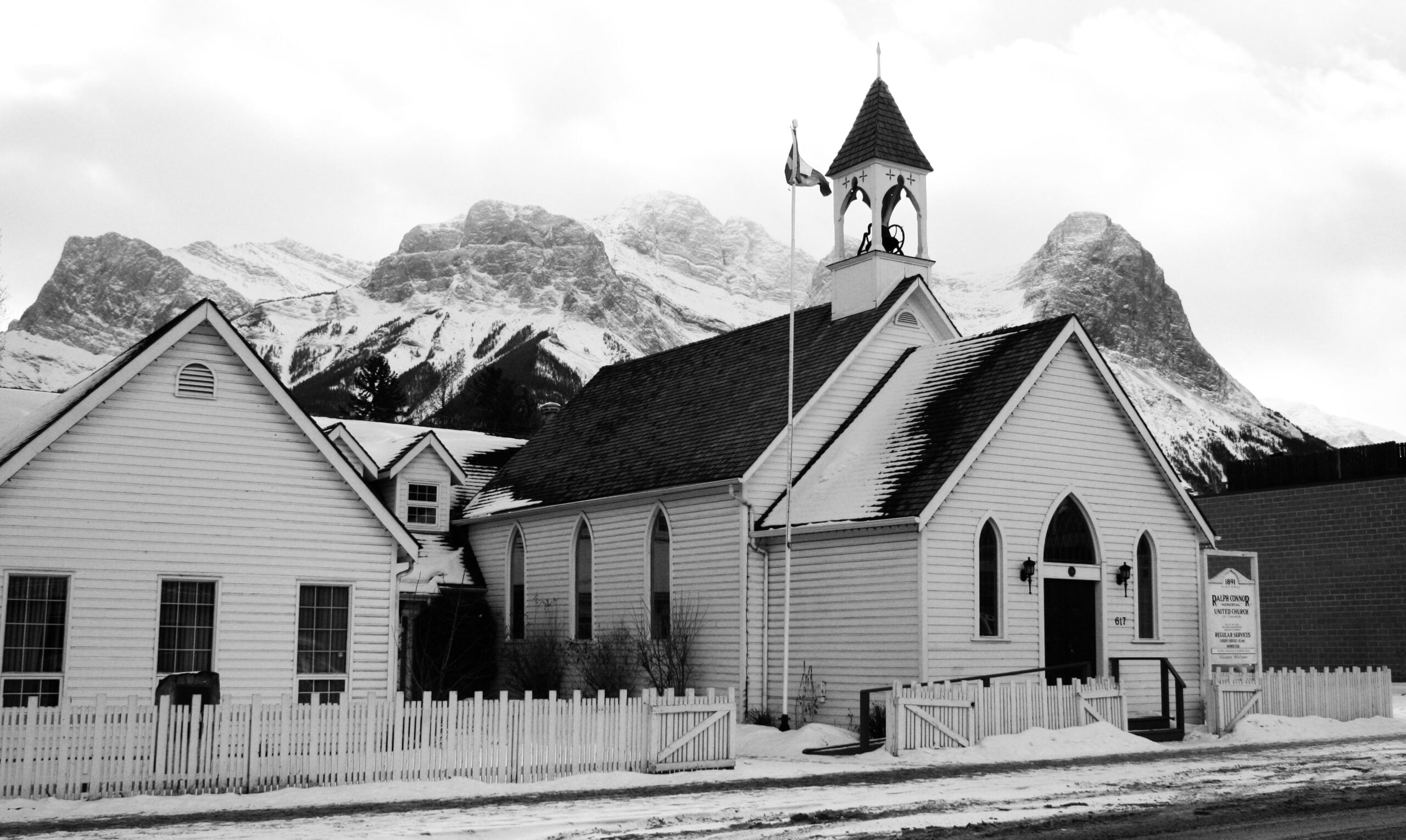
A small church on Canmore’s 8th Street carries a novelist’s name. Part of that name, according to the writer himself, began with a misread telegram.
Charles Gordon had wanted to publish under “Cannor,” a shortened form of Canadian Northwest. A telegraph operator sent “Connor” instead. Readers came to know him as Ralph Connor, the author of stories drawn from life in the West.
Before the books, there was the work that gave him something to write about: ministry among mining communities in the Rockies.
It is an unexpected introduction to the churches in Canmore. Their history includes a literary career, a meeting in a log schoolhouse and families who helped build their church with borrowed machinery. Follow those stories and you begin to see the town through the people who made a home here.
The minister who turned to fiction
Gordon helped build the church now called Ralph Connor Memorial in 1890 and 1891. Alberta’s heritage record connects the building with his early ministry and the mountain experiences that later shaped his novels.
His reason for writing was practical. He wanted readers in Eastern Canada to understand and support Presbyterian mission work in the West. Fiction gave him a way to bring that distant world to their attention.
The stories developed into Black Rock. Its success, followed by The Sky Pilot, brought him a wide readership. The University of Manitoba’s account of Gordon’s life also preserves his explanation of the telegram.
The books travelled much farther than the little church. Yet the building is where the connection between the minister and the novelist becomes tangible. Here was a community he served before readers elsewhere knew his pen name.
The church is now a Provincial Historic Resource. You can appreciate its survival without knowing its literary history, but the name above the door becomes more interesting once you do.
A congregation begins in a schoolhouse
A few years after Gordon’s church took shape, another group gathered to discuss what they hoped to build.
It was an October evening in 1893. The meeting took place in Canmore’s one-room log schoolhouse, and the Anglican priest from Banff, Reverend William Henry Barnes, helped get the project started.
There was enthusiasm, but little money. Four years later, St. Michael’s Anglican Church was consecrated, with the building already paid for. The parish’s history remembers the achievement alongside the purpose of the church: a place for baptisms and marriages, and support when someone died.
That purpose brings the story close. Behind the dates are the kinds of occasions every family recognizes: a child welcomed, a couple married, neighbours gathering after a loss. The little congregation wanted somewhere to meet those moments together.
The parish also offers visitors a simple direction. Stand outside the sanctuary door and look south towards the Three Sisters. The view connects a quiet corner of the town with the mountains that have accompanied its whole history.
The families who built Sacred Heart
Canmore’s Catholic community began its own small white church in 1893. By 1960, it needed more room.
The replacement became a community project. Canmore Mines supplied machinery and much of the building material. Volunteers worked in teams. Families contributed what they could, and the new Sacred Heart church was completed in six months.
The parish’s published history remembers the families and miners who made it possible. Their work gives the building date its meaning. A church appeared because people found time, equipment and money to put towards it.
Decades later, the same parish prepared for another move. The Shrine Church of Our Lady of the Rockies was dedicated on May 30, 2020, during pandemic restrictions. The dedication Mass was livestreamed; the first public Mass followed on June 8. After the work of creating a new gathering place, gathering itself had become difficult.
Inside, a stained-glass window places Mary and Jesus in a forest, with deer, water and the Three Sisters behind them. Catholic News Service’s report on the opening describes the image and the parish’s hopes for its new home.
There is a connection here with St. Mary’s in Banff, where local mountains also appear in sacred art. In both places, worshippers can recognize the landscape outside their doors within the story of their faith.
Finding your own connection in Canmore
A novelist’s church, a schoolhouse meeting and a construction project shared by miners’ families offer three ways into Canmore’s history. Each begins with people trying to make something possible together.
They also invite a different kind of visit. At Ralph Connor Memorial, pause over the name. At St. Michael’s, look towards the Three Sisters. At Our Lady of the Rockies, find those same peaks in the window.
These are working congregations, so check with Ralph Connor Memorial, St. Michael’s or Our Lady of the Rockies about services and visiting. Their histories are a starting point for exploring the town’s Christian communities.
Search FaithFinder’s church directory for churches in Canmore and across Alberta.
Continue with Faith in the Bow Valley Beyond the Church Doors, the final part of this series.
Credit: Photo: Wapise, via Wikimedia Commons, CC BY-SA 3.0. Photographed in 2011.