Historic Churches in Calgary and the Stories Behind Their Sandstone Walls
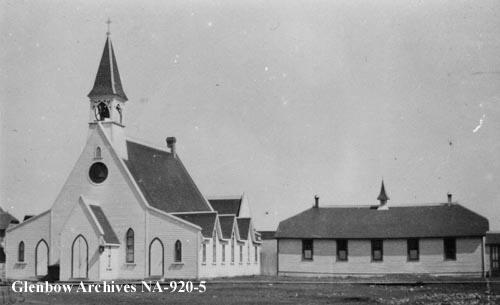
Calgary’s oldest churches are older than the city itself. Congregations met in a log cabin and a trading company’s store before Calgary was incorporated, and one church was hauled across a frozen river when the railway moved the town.
After the railway arrived in 1883, several of those congregations rebuilt in local Paskapoo sandstone. This post visits the historic churches in Calgary that still stand, from the mission that named a neighbourhood to a Chinatown church from the 1950s.
Calgary sits where the Bow and Elbow rivers meet, in Treaty 7 territory, on lands long known to the Blackfoot Confederacy, the Tsuut’ina, the Stoney Nakoda and the Métis. Christian missionaries travelled through well before any church was built. Methodist Robert Rundle reached Big Hill Springs, near today’s Cochrane, in 1841 (Dictionary of Canadian Biography). His story is part of our history of Christianity in the Bow Valley.
This is the first of three FaithFinder features on historic churches in and around Calgary. Part 2 follows the old Macleod Trail south to the foothills, and Part 3 visits the prairie towns north and east of the city.
St. Mary’s Cathedral and the mission that named a neighbourhood
Calgary’s Catholic story begins outside the city. In 1872, a Métis man named Alexis Cardinal built a log cabin between today’s Bragg Creek and the Trans-Canada Highway. The next year, Father Constantine Scollen of the Oblates of Mary Immaculate established the Mission of Our Lady of Peace there (Diocese of Calgary).
In 1875, Father Leon Doucet joined him and the mission moved closer to Fort Calgary, later settling beside the Elbow River. A stone cairn now marks the original site, which the Province designated in 1976.
The mission shaped the district around it. In 1884, Father Albert Lacombe oversaw the subdivision of the mission townsite. The Faithful Companions of Jesus opened the Sacred Heart Convent in 1885 and began the first French-language Catholic schooling in southern Alberta. In 1892, the Grey Nuns founded Holy Cross Hospital. By 1899, about 500 people had formed the Village of Rouleauville, today’s Mission neighbourhood (Heritage Inspires YYC).
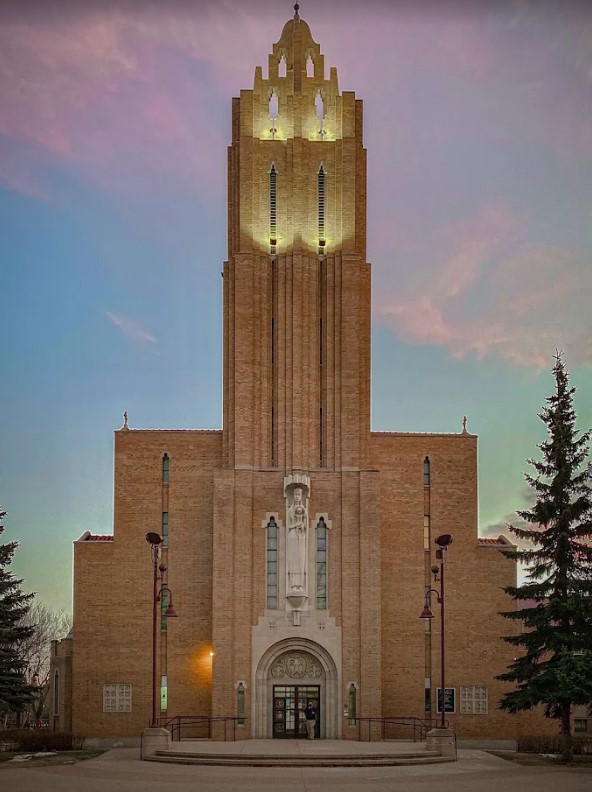
St. Mary’s was built of sandstone in 1889 and became the cathedral when the Diocese of Calgary was created in 1912. By the 1950s it was too small. Demolition began in July 1955, and the present cathedral was consecrated on December 11, 1957 (St. Mary’s Cathedral).
The new building was designed by Maxwell Bates, also remembered as one of Alberta’s best-known painters, with Alfred Hodges. Above the entrance stands a 4.9-metre stone statue of Mary and the Christ Child by sculptor Luke Lindoe. Only one thing came from the old church: four bells donated in 1904 by rancher and senator Pat Burns.
Knox United: Calgary’s oldest Protestant congregation
Knox began in 1883 as a Presbyterian congregation meeting in the I.G. Baker store in what is now Inglewood, under Rev. Angus Robertson. Its first wooden church cost about $1,000 (Knox United history).
Then the railway moved the town. In 1884, the congregation hauled its church on skids across the frozen Elbow River to its new location. A larger church followed in 1886, and another in 1905.
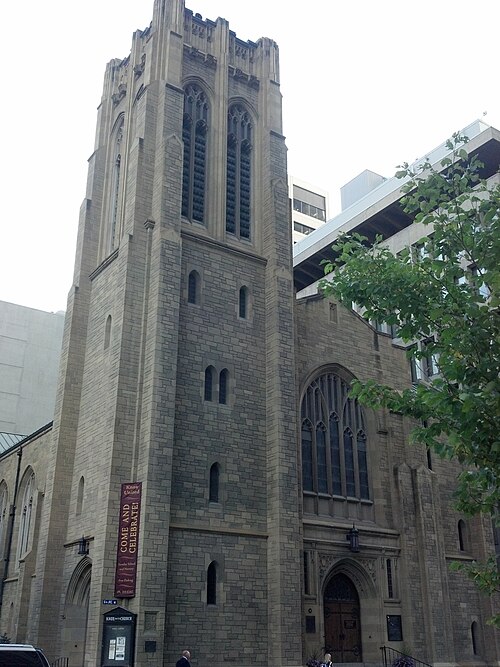
The present Paskapoo sandstone church was completed in 1912 and 1913. It is the home of Calgary’s oldest Protestant congregation and, for many years, was the tallest building in the city (Canadian Register of Historic Places). Knox joined the United Church of Canada in 1925 and was designated a Provincial Historic Resource in 1980.
Look for the 37 memorial windows, including the First World War window “The Suffering of Mankind,” installed in 1921. The 1912 Casavant organ has been rebuilt twice and now has more than 5,000 pipes.
Cathedral Church of the Redeemer: a royal screen and a Mountie’s bell
On August 3, 1884, a small wooden church opened beside what is now Paget Park. It was the first Anglican church built in what became the Diocese of Calgary (Cathedral history). It became a temporary cathedral in 1889.
The sandstone church that replaced it opened on July 30, 1905. Its architect, J.C.M. Keith, had also designed the little Anglican church at Midnapore twenty years earlier, featured in Part 2. The stone came from the Oliver quarry, and the fish-scale metal roof was the first metal roof in Calgary (Canadian Register of Historic Places).
Inside, look for stained glass by William Morris & Co., an oak rood screen dedicated by the Prince of Wales in 1919, and a 1906 Casavant organ. The bell in the tower hung first in the 1884 church. It was given in memory of Corporal Lowry of the North West Mounted Police, who died during the North-West Resistance of 1885.
The church became a full cathedral in 1949 and a Provincial Historic Resource in 1977. Even the trees have a history: a maple in Paget Park was donated by the Canadian Pacific Railway in 1908.
Grace Presbyterian: a circular sanctuary in sandstone
Grace Presbyterian’s congregation formed in 1905 and has held services in its present church since 1913. The sandstone building, designed by Smith & Gemmell, has a rare circular sanctuary with a gallery and a three-storey bell tower (Heritage Calgary).
Heritage Calgary calls it beautifully crafted and highly intact. The 1962 Reeve Memorial Chapel was added with care to sit alongside the original. The church stands on a corner of 15 Avenue SW and remains a neighbourhood landmark.
Chinese United Church: a 1950s landmark in Chinatown
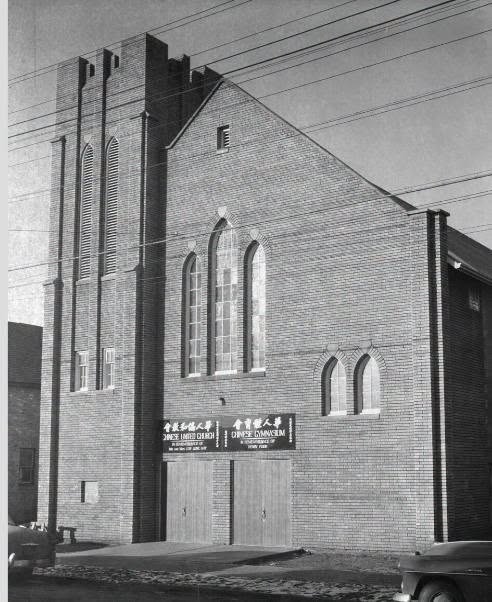
Before the present church, Calgary’s Chinese community had a Christian mission building in Chinatown. In 1953 and 1954, the congregation built the Chinese United Church next door to the old mission, with both a sanctuary and a gymnasium (Heritage Inspires YYC Chinatown guide).
Its architect was Maxwell Bates, who designed St. Mary’s Cathedral a few years later. The church was one of Chinatown’s first buildings after the Second World War. The old mission became a rooming house for students and seniors, and its site is now Oi Kwan Place, a seniors’ home.
A history to remember
Calgary also had a residential school. St. Dunstan’s, also called the Calgary Industrial School, was run by the Anglican Church from 1896 to 1907 in Ogden, above the Bow River (Heritage Calgary).
In 1899, Jack White Goose Flying, a 17-year-old from the Piikani Nation, died there of tuberculosis and was buried on the hill above the school. In 1956, historian Hugh Dempsey and Senator James Gladstone, who had attended the school with him, identified the grave. When industry threatened the site in 1971, his remains were moved to Queens Park Cemetery.
Church history in Calgary includes this story too. Remembering it honestly is part of caring for the city’s heritage.
Visiting historic churches in Calgary
Most of these churches are active congregations, so check service times and visiting hours before you go, and ask before photographing interiors.
- Knox United Church, 506 4 Street SW, offers a walking tour.
- Cathedral Church of the Redeemer, on 7th Avenue beside Paget Park.
- St. Mary’s Cathedral, in the Mission district.
- Grace Presbyterian Church, 1009 15 Avenue SW.
- Chinese United Church, 124 2 Avenue SW.
For a church you can see any day the park is open, visit St. Martin’s Anglican Church at Heritage Park. Built around 1896 near Lundbreck by carpenter George Johnson, it cost $110, plus $4 for the seats. Lundbreck gave it to Heritage Park in 1964, and it still hosts weddings and special Sunday services.
Looking for a church home in Calgary? Search FaithFinder’s Alberta church directory and choose Calgary to see local churches.
Read the series: Prairie and Foothills Faith
- Historic churches in Calgary (you are here)
- Historic churches south of Calgary
- Prairie churches near Calgary