Calgary Before the Skyline is a four-part FaithFinder series about historic Calgary churches and the people who built, moved, protected and kept using them. Each feature follows one of the four churches in this collection.
Series introduction
A warning nailed to a church door. A wooden building hauled across a frozen river. A “temporary” cathedral title that lasted sixty years. Calgary’s old churches have stories worth stopping for. Follow FaithFinder through Midnapore and downtown to meet four congregations whose histories reach well beyond their buildings.
These churches stand in the Treaty 7 region, on lands with Indigenous histories and spiritual traditions extending far beyond the settler communities described in this series.
St. Paul’s Midnapore and the Church That Would Not Move
Calgary Before the Skyline · Part 1 of 4
In 1896, someone nailed a warning to the door of St. Paul’s Church.
Anyone attempting to take the building away would face prosecution.
The dispute was rather more complicated than a church theft. According to the Midnapore Church of England Society, parishioners from Pine Creek had apparently obtained diocesan permission to move the church to their community. They were on their way with horses and wagons when one of the party rode ahead and discovered the notice.
He went back to report what he had found. The party turned around.
St. Paul’s stayed put.
The society preserves the account and the wording of the notice, signed on July 13, 1896, by S. W. Shaw for the trustees and W. Henry Wood for the original subscribers. Whatever permission the prospective movers believed they had, the people who wanted their church to remain in Midnapore had made their position unmistakable.
It is a memorable introduction to one of Calgary’s oldest surviving church buildings. The little chapel beside Macleod Trail has been giving people reasons to care about it since 1885.
Before Midnapore became south Calgary
The church began in a community then known as Fish Creek, along the route between Calgary and Fort Macleod. John Glenn donated land, and the first service was held in September 1885.
The building was wooden, with pointed windows and a steep roof. The style is called Carpenter Gothic: the familiar shapes of Gothic church architecture translated into timber. Here, those shapes belonged to a small rural church rather than a great stone cathedral.
Its usefulness soon extended into the school week. From 1887 to 1891, Helen Millar (Shaw), taught local children in the church. Alberta’s heritage record identifies both its religious and educational roles.
That classroom helps explain the attachment to the building. Families had put a church and a school into one small space. Moving it meant moving something woven into community life.
The chapel’s history also has a neighbourly connection that is easy to miss. John Glenn was Catholic. Nineteen years after the Anglican church opened, his son Patrick provided land for the Catholic church nearby. We will meet that second building, Old St. Patrick’s, later in this series.
A bell with an English past
The chapel’s bell had a life before Midnapore.
It came from St. Andrew the Apostle in Thelveton, Norfolk, England. Its inscription records a casting in 1762 and a recasting in 1925. The society’s bell history includes a 1933 account of its transfer to the Alberta church.
A small prairie chapel had acquired a voice from an English village. The bell’s own inscription offers a more concrete connection with that past than the romantic claims sometimes made about its age.
The building itself has needed help to keep going. In the 1940s, parishioners removed a deteriorating steeple. In 1987, the church was lifted so a concrete basement and more stable foundation could be built beneath it. The chapel’s heritage history describes those changes.
Old buildings survive through work like that. Someone notices the rot. Someone raises the money. Someone arranges the repairs.
The people still looking after it
Today, volunteers with the Midnapore Church of England Society care for the chapel, cemetery and grounds.
Their reasons are often personal. On the society’s website, a volunteer named Linnea remembers walking to church with her grandmother. Her great-great-grandparents helped build the church, and members of her family are buried in its cemetery.
For her, preserving St. Paul’s means keeping a physical connection with those people. Other volunteers describe their own family and community ties.
The 1896 notice suddenly feels less remote. Across the generations, people have kept deciding that this little church belongs in their lives.
If you visit, distinguish the historic Midnapore chapel from the present-day St. Paul’s parish church at Sunmills Green. Contact the parish or the society about chapel access before making plans.
You may arrive curious about an old building. You will leave knowing that, on one memorable occasion, keeping it there required a warning on the door.
Explore FaithFinder’s church directory to find a congregation in Calgary or elsewhere.
Next: The Cathedral Church of the Redeemer and Sixty Years of Temporary.
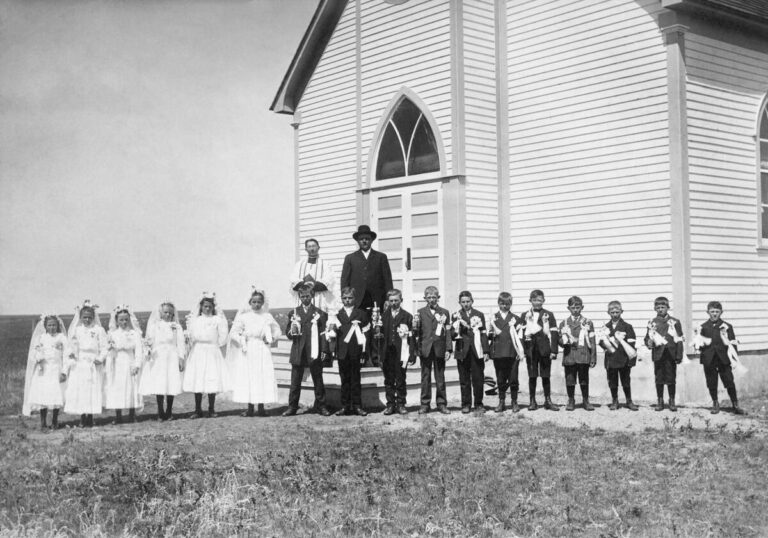
Photo Attribution: Midnapore and Macleod Trail, Alberta.”, [ca. 1914], (CU1154624) by unknown. Courtesy of Glenbow Library and Archives, Glenbow Archives Collection, Libraries and Cultural Resources Digital Collections, University of Calgary.